

Bandhavgarh National Park
The Bandhavgarh National Park in Madhya Pradesh, India is best known for its tiger population. With a combined 448 square km of the protected and buffer zone, this national park is home to a large biodiversity. The name of this park comes from a nearby hill on which an ancient fort is located that dates back 2000 years. According to the legends, Hindu God Ram gave this fort to his brother Lakshman to keep a watch on the demon kingdom of Lanka. Before being declared a national park in 1968, the forest covered area of Bandhavgarh was used as a game preserve by the kings and their guests.
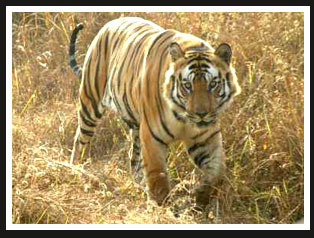
Tiger, Bandhavgarh National Park
Sal forest covers more than half the area of Bandhavgarh National Park. The moist deciduous forest of Bandhavgarh National Park houses all the animal species that are typically native to the habitat in central India. The biodiversity of Bandhavgarh National Park includes a wide variety of vegetation, mammals, birds and reptiles. This park has the highest density of Bengal tigers in India. Besides tigers, the other predators of this region are Asiatic Jackal, Sloth Bear, Gray Mongoose, Striped Hyena, Bengal Fox, Jungle Cat and Leopard. Other animals found in this region are Wild Pigs, Spotted Deer, Sambar, Chausingha, Nilgai, Chinkara, Gaur, Dhole, the small Indian Civet and Palm Squirrel.
Bandhavgarh National Park is also home to over 250 species of birds. Some of these birds are Sarus Crane, Black Ibis, Lesser Whistling Teal, White-eyed Buzzard, Black Kite, Crested Serpent Eagle, Black Vulture, Common Peafowl, Red Jungle Fowl, Dove, Kingfishers and Indian Rollers. This makes Bandhavgarh National Park a great place for bird-watching.
Location of Bandhavgarh National Park
Located on the Vindhyan hill range, the altitude of Bandhavgarh National Park varies from between 44 to 81 meter above sea level. The nearest airport is in Khajuraho, which is 240 km away (4-hour drive). Umaria is the nearest railway station located 48 km away.
Bandhavgarh National Park Climate
Winter nights are freezing (2°C; 36°F), summer unpleasantly hot (maximum 42°C; 108°F
When to go?
February to May is favourable; park remains closed from beginning July to end October).
How to Reach Bandhavgarh National Park
Private bus and car hire available from Umaria (32km; 20 miles), Amarpatan (80km; 50 miles), Shahdol (97km; 60 miles) and Rewa (105km; 65 miles), as well as from Khajoraho and Satna..
Facilities at Park
Accommodation provided by the MPSTDC (Wriite Tiger Forest Lodge) and many private lodges at Tala (Bandhavgarh Jungle Camp - former Maharaja of Rewa's palace - and Tiger Trails). Visitors may enter park in their own vehicles (petrol only as diesel banned here); alternatively hire a taxi at Tala (park entry point). Park open from dawn to dusk. At entry gate, trained guides with interpretive skills can lead visitors through the park.
Booking for Bandhavgarh National Park
Prior booking essential; write to: The Manager, White Tiger Forest Lodge, Madhya Pradesh State Tourism Development Corporation: Umaria. Shahdol District, Madhya Pradesh; dr Tourist Officer, Head Office, MPSTDC, 4th Floor Gangotri,T T Nagar,Bhopal.
Conservation History
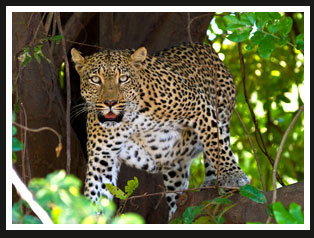
Leopard, Bandhavgarh National Park
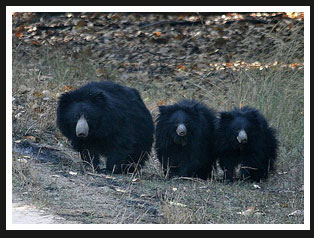
Sloth Bear, Bandhavgarh
Archeology
Mythologically the fort was built by Lord Rama for his brother Laxman, during Ramayan period. There are a number of man made caves (35) in Bandhavgarh with inscriptions and carvings, which date back between about 129-168 A.D. Statues of various incarnations of Lord Vishnu, which were carved out of single rocks are found in the fort. "Sheshshaiya" the statue of lord Vishnu in reclining pose is the biggest of all and attracts every tourist. These statues date back to 10-11th Century A.D.
BOOK NOW
Forest Types
Main Species (Flora)
Sal, Saja, Dhauda, Tendu, Arjun, Aonla, Pals, Salai, Bhirra, Khamer, Dhaman, Mango, Jamun, Bamboo, etc.
Main Species (Fauna)
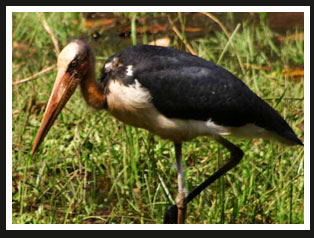
Lesser Adjutant Stork, Bandhavgarh
Mammals: Spotted deer or Chital, Sambar, Barking deer or Muntjac, Chausinga or Four-horned antilope, Nilgai or Blue bull, Indian Gazel or chinkara and Tiger, Leopard, wild dog or Dhole, Wolf, Scavangers consists of Hyena, jackal, Wild boar, Sloth bear, Common Langur, Rhesus monkey etc.
Bird: 242 species of birds have been identified in the Reserve. Commonly seen are Peafowl, Red Jungle fowl, Grey Hornbill, Common Teals, Red Wattled Lapwing, Crested Serpent Eagle, White Breasted Kingfisher, Lesser Adjutant Stork, etc.
Reptile: Cobras, Kraits, Vipers and Python
Faunalisted in the Schedules of WPA, 1972
BOOK NOW
Tiger (Panthera tigris), Leopard (Panthera pardus), Jungle Cat (Felis chaus), Wolf (Canis lupus), Jackal (Canis aureus), Indian Fox (Vulpes bengalensis), Wild Dog (Cuon alpinus), Sloth Bear (Melursus ursinus), Ratel (Mellivora capensis), Hyaena (Hyaena hyaena), Chinkara (Gazella gazella) and Chowsingha (Tetraceros quadicornis). Amongst birds are Malabar Pied Hornbill and amongst reptiles Indian Varanus (Varanus bengalensis) and Python (Python morulus).
