

Corbett National Park
Corbett National Park is also known as Jim Corbett National Park and is named after Jim Corbett, a renowned hunter who turned into a conservationist and author after his retirement. It is located on the foothills of Himalayas and falls in the Nainital district of Uttarakhand state. It was established in 1936 and was previously known as Hailey National Park. Corbett National Park is the first national park of India. It was also the first protected area to become a part of Project Tiger launched by the government of India for the protection and conservation of Bengal Tigers. The sub-Himalayan belt geography and ecology allow a comforting habitat for 488 different species of plants, 110 tree species, 50 species of mammals, 580 bird species and 25 reptile species.
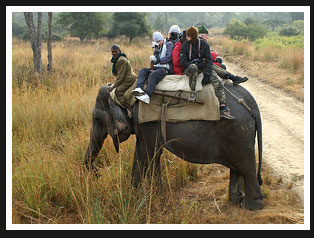
Elephant Safari, Corbett
Corbett Park is a heaven for wildlife and ecotourism. The core area of the park encloses 520 sq. km of land comprising hilly areas, river belts, grasslands and lakes. The splendid landscape of Corbett is what attracts a majority of tourists. But the main attraction of this park is the Bengal tiger. It is one of the best places to see tigers in their natural habitat in north India. It is also a popular destination for wildlife and adventure activities. It is just four hours-drive away from Delhi, thus, making it a great weekend destination for the people of Delhi and its surrounding areas.
The wildlife of Corbett Park, besides Bengal tigers, includes leopards, jungle cat, fishing cat and leopard cat. Deer, Sloth, Himalayan Black bears, Indian Grey Mongoose, otters, Indian pangolins, langur and rhesus monkeys are some of the mammals found in this park. The park also houses many migrating and resident birds. Many wildlife photographers also choose Corbett Park because of this diverse wildlife and breath-taking natural landscape.
Location of the Park: Situated at an altitude of 120 and 400m (400 and 1250ft). Nearest railhead is at Ramnagar, approximately 19km (12 miles) southeast of the park. Nearest airport is at Pantnagar 50km (30 miles) away.BOOK NOW
Corbett National Park Climate : Summer temperatures soar to 43°C (108°F) at max and 19°C ( 42.5°F) at Min., while on winter day temperature rises to 25°C (46°F) and dips to 3°C (33°F) .
When to go: Best period is between November and May; visibility of wildlife is better in the drier summer. Park remains closed in wet monsoon season from July to October.
How to Reach: The Delhi-Moradabad National Highway connects the Kashipur-Ramnagar-Dhikala network of towns. Project Tiger headquarters are at Ramnagar, mandatory entry point for the park. Bus services operate regularly along the Nainital-Kathgodam-Ramganagar-Dhikala route.
Facilities at Park: Basic facilities at Dhikala (forest rest houses and log huts), which has a canteen and shop selling provisions. Forest rest houses at Sarapdull, Gairal and Bijrani, all within the park. More up market hotels in nearby Ramnagar; Corbett Infinity Resort (Tiger Tops), Corbett River Side Resort are good to relax.
Booking for Corbett National Park : Contact : The Field Director, Poject Tiger, Corbett Tiger Reserve, Post Office; Ramnagar, Nainital District, Uttranchal
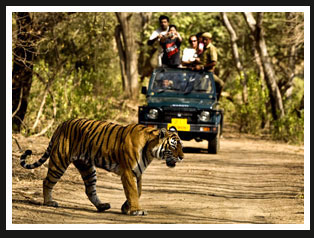
Jeep Safari, Corbett
Conservation History
Jim Corbett National Park was initially known as the Hailey National Park until 1954. In 1955, its name was changed to Ramganga National Park and was again renamed as Corbett National Park in 1955-56. Corbett was also one of the first nine reserves to be included in the Project Tiger campaign. It is one of the largest national parks in India with a total area of 1318 sq. km. In 1868, during British rule, the first step was taken by the British forest department for the conservation of this area. It established a control over the land and prohibited cultivation. After it was declared a national park in 1936, hunting and capturing of animals, reptiles and birds were banned within the park's boundary. In 1991, the area of Kalagarh forest division and Sonanadi Wildlife Sanctuary were added to Corbett National Park.
BOOK NOW
Forest Types
Northern Moist Deciduous, Northern Tropical Dry Deciduous, Himalayan Subtropical Pine Forests
Main Species(Flora)
Sal, Khair, Sissoo, Ber, Kuthber, Bel, Chbilla, Dhak, Semal, Khingan, Kharpat, Rohini, Bakli, Pula and Bamboo
Main Species(Fauna)
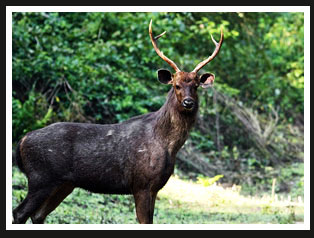
Sambar Deer, Corbett
Birds : Peacock, Jungle Fowl, Partridges, Kaleej, Crow, Vulture, Parakeets, Laughing Thrush, Orioles, King Fishers, Drongo, Doves, Woodpeckers, Ducks, Teals, Storks, Cormorants and Seagulls .
Reptile : Indian Marsh Crocodiles Or Mugger , Gharials , King Cobra, Common Krait , Cobra, Russel , Python and Monitor Lizard .
Pisces : Mahaseer , Kalimuchi , Kalabasu , Chilwa and Goonch.
